

A weak pipeline does not always mean your strategy is failing. In many cases, it means something is breaking down across marketing, lead capture, qualification, follow-up, CRM visibility, or sales execution.
You cut marketing. Replace a salesperson. Change target markets. Add tools. Blame the CRM. Try more AI. Shift budget. Then six months later, you still do not know what was actually blocking progress.
In most cases, the problem is not effort. It is diagnosis.
At KLA Group, we help B2B companies diagnose what is blocking opportunity creation across sales, marketing, CRM, and AI so they can make better decisions before cutting spend.
Key Takeaways
- A weak pipeline is often a symptom, not the diagnosis.
- The real issue may be lead capture, qualification, follow-up, stage progression, CRM visibility, shared definitions, or sales capacity.
- Pipeline and forecast are not the same thing, and confusing them leads to bad decisions.
- Better visibility across sales and marketing helps you see what is working and where momentum breaks down.
- Sales, marketing, CRM, and AI should support one revenue system, not operate as separate activities.
- Before you cut spend, you need to know what is broken and what is actually creating opportunities.
Why does a pipeline look broken when the real issue is somewhere else?
Because most leaders are looking at the result before they can see the cause.
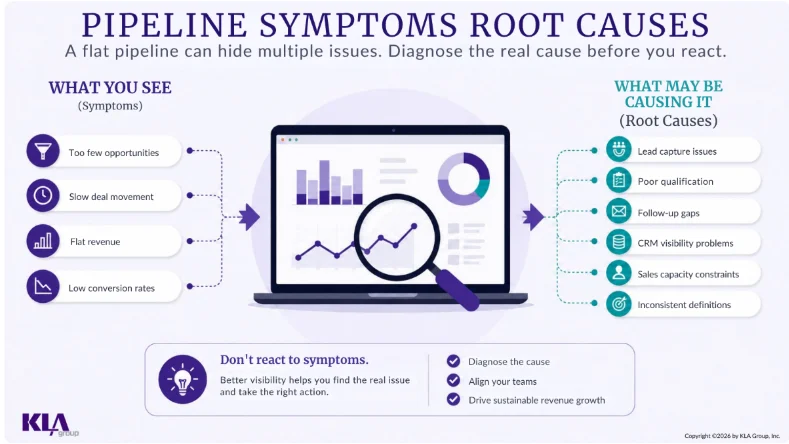
You look at the pipeline and see too few opportunities, slow movement, weak conversion, or flat revenue. That is real. But it still does not tell you why it is happening.
The issue may be top-of-funnel volume. It may also be something else entirely.
You may be seeing any of these symptoms:
- Marketing is active, but qualified opportunities are inconsistent
- Sales is busy, but deals are not moving
- Leads are coming in, but follow-up is uneven
- Opportunities exist, but they are not being logged correctly
- Your CRM has data, but you still cannot see what is driving revenue
- AI tools are in use, but productivity has not improved
A flat-looking pipeline can hide several different problems under one number. If you do not separate them, every fix becomes a guess.
Decisions leaders make too quickly
They make the decisions that feel logical before they have enough visibility.
That usually sounds like this:
- We need more leads
- Marketing is not working
- Sales is not doing enough
- The CRM is the problem
- Our target market must be wrong
- We need more automation
- We need better AI tools
- We should cut spend until this improves
Sometimes one of those decisions is right. Often it is premature.
A flat pipeline can push you into reaction mode. That is when companies make dramatic changes before they know whether the real issue is lead quality, stage progression, follow-up, messaging, qualification standards, or sales capacity.
That is also when good activity gets cut for the wrong reason.
What is the difference between pipeline and forecast?
Your pipeline is the full list of opportunities across every stage. Your forecast is the smaller group of opportunities you expect to close in the near term.
That distinction matters because leaders often treat them as the same thing.
When that happens, short-term pressure drives long-term decisions. Marketing gets told to generate more volume. Sales gets pushed to close deals that are not ready. Leadership focuses on totals without seeing how opportunities move from first touch to close.
If you cannot see that movement, you cannot tell whether the real issue is marketing quality, sales execution, CRM discipline, or forecast accuracy.
A number by itself does not give you the diagnosis. Visibility does.
If you want a broader view of how these pieces work together, this overview of a revenue generation system gives useful context.

3 areas to inspect when a pipeline feels stuck
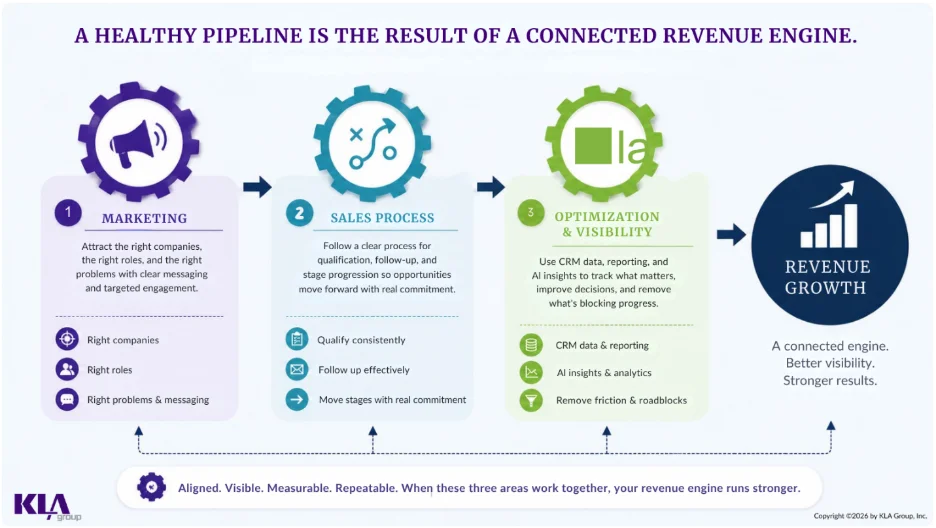
In the webinar, Kendra Lee breaks the issue into three areas: marketing, sales process, and optimization.
She does not look at pipeline performance as a sales-only problem. She looks at whether the full revenue engine is producing, capturing, moving, and measuring opportunities the right way.
1. Marketing
Is your marketing attracting the right companies, the right roles, and the right problems?
If your positioning is broad, your target market is vague, or your messaging does not reflect real buyer concerns, activity can stay high while opportunity quality stays low. That is why targeted digital marketing services matter more than generic campaign activity.
2. Sales process
Does sales follow a clear process for qualification, follow-up, and stage movement?
If reps are interpreting stages differently, following up inconsistently, or moving deals forward based on activity instead of real commitment, your pipeline becomes difficult to trust. A documented sales process supported by sales training programs gives you a more reliable view of what is really happening.
3. Optimization and visibility
Can leadership actually see what is happening across sales and marketing?
This is where HubSpot implementation and AI matter. Your CRM should show where opportunities stall, where follow-up breaks down, which sources create qualified conversations, and where effort is being lost. AI should help the team move faster, not create more noise.
Clear reporting also matters. These examples of HubSpot dashboards show how better visibility helps leaders make better decisions.
What breaks before revenue shows the damage
Revenue usually feels the impact last.
Before that happens, you tend to see smaller breakdowns across the system:
- Leads are not being created consistently
- Leads are being created but not captured well
- Marketing and sales are using different definitions of qualified
- Stage movement is based on rep activity rather than buyer commitment
- Sales capacity does not match lead volume
- Follow-up is delayed
- CRM usage is inconsistent
- Reporting shows activity, but not what is actually creating opportunities
This is why CEOs often feel the symptoms before they can see the root cause.
They know something is off. They just cannot see where the loss is happening.
What should you look for before cutting spend?
Start with questions, not fixes.
Before you change strategy, reduce budget, replace people, or add new tools, step back and ask:
- Are we confusing pipeline with forecast?
- Are all real opportunities being captured in the CRM?
- Do sales and marketing use the same definition of qualified?
- Are deals moving because the buyer is committed, or because activity happened?
- Can sales follow up fast enough on the volume marketing is generating?
- Can leadership see which efforts are creating qualified opportunities and revenue movement?
- Is AI helping speed execution, or just adding another layer of activity?
You do not need a dramatic change first. You need clearer visibility first.
If you want a deeper look at where execution usually breaks down, sales coaching can help expose the issues faster.
Why visibility leads to better decisions
Because clarity leads to better decisions.
When you can see what is working, you stop guessing. You stop reacting to symptoms. You stop making cuts that reduce opportunity creation without fixing the actual problem.
Marketing can see which campaigns produce qualified conversations. Sales can see which actions move deals forward. Leadership can see whether the issue is lead volume, lead quality, follow-up, stage progression, or process discipline.
That is what gives you confidence.
And confidence is what leads to more consistent execution.
KLA Group’s view of pipeline diagnosis is that better visibility across sales and marketing leads to better decisions, more consistent execution, and stronger revenue results.
See the full diagnostic breakdown in the webinar
This article gives you the framing. The full Coffee with Kendra webinar walks through the diagnostic logic in more detail, including the patterns leaders miss, the questions to ask, and the areas to inspect before you make a major change.
If your team is busy but you are still not seeing enough qualified opportunities or revenue results, do not jump straight to cutting spend.
Explore KLA Group’s digital marketing services, sales coaching, and HubSpot implementation services at klagroup.com to diagnose what is blocking opportunity creation and improve visibility across sales and marketing before you cut spend.
Frequently Asked Questions About Diagnosing a Broken Sales Pipeline
Answers to common questions about flat pipelines, marketing spend, CRM visibility, AI, and revenue performance.
Why can a pipeline look weak even when activity is high?
Because activity does not always produce measurable opportunities. You may have campaigns running, reps making calls, and data in the CRM, but still have breakdowns in qualification, follow-up, messaging, or visibility.
Should you cut marketing when pipeline slows down?
Not until you know what is actually blocking opportunity creation. If the issue is follow-up speed, qualification, stage movement, or CRM visibility, cutting marketing may reduce opportunities without fixing the problem.
What is the first thing to check in a flat pipeline?
Start by separating pipeline from forecast. Then look at whether opportunities are being created, captured, qualified, and moved consistently across sales and marketing.
How do CRM and AI fit into pipeline diagnosis?
CRM gives you visibility into what is happening across marketing and sales. AI can speed execution, summarize activity, and help teams respond faster. But neither will fix a weak process on its own.
What should leaders want most when pipeline performance drops?
Clarity. You need to know what is broken, what is creating opportunities, and what needs to change before you shift budget, change strategy, or replace people.
About KLA Group
KLA Group is a strategic sales consultancy and digital marketing agency based in the Denver, Colorado area. We’re passionate about helping small and midsize businesses build and expand their revenue engine. Our clients rely on us to deliver sales consulting, training, digital marketing, and AI-powered programs that drive sustainable growth. We bring both strategy and execution to every engagement. As a HubSpot Gold Partner, we offer added expertise to clients using the platform. Our global clients value our deep experience and the respect and joy we bring to every relationship.
About The Author
Revenue generator and founder of KLA Group, Kendra Lee helps small and mid-sized companies grow revenue by getting seen, getting heard, and getting traction with sales, marketing, and AI strategies that cut through the noise. She’s the author of The Sales Magnet with her third book, From Chaos To Revenue, coming 2026.
Read More Related Articles